Sack Back Windsor Arm Chair

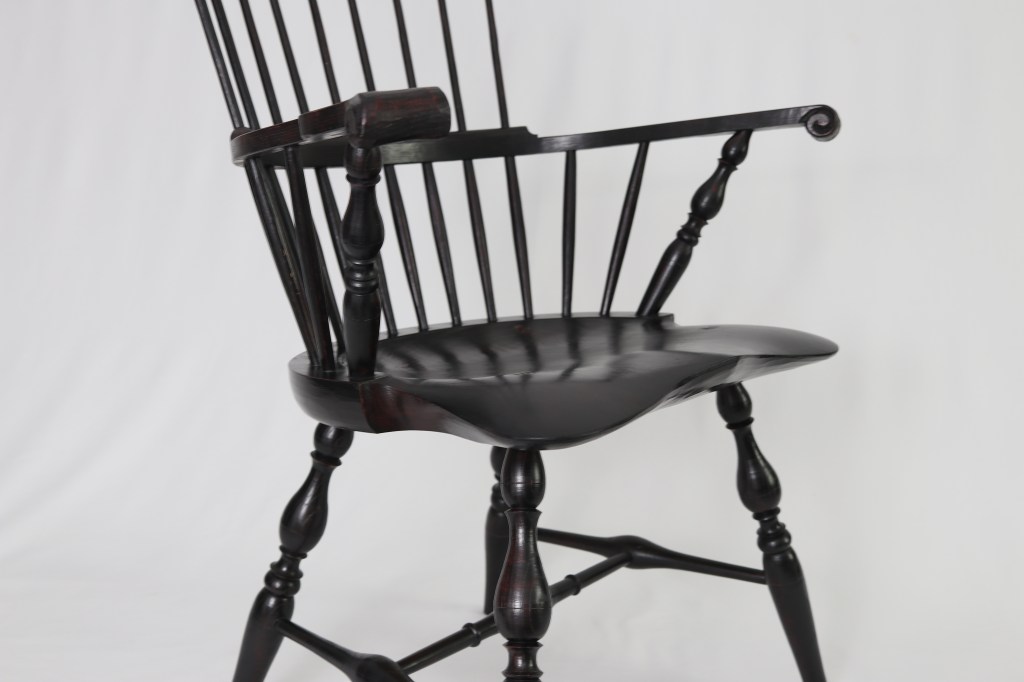
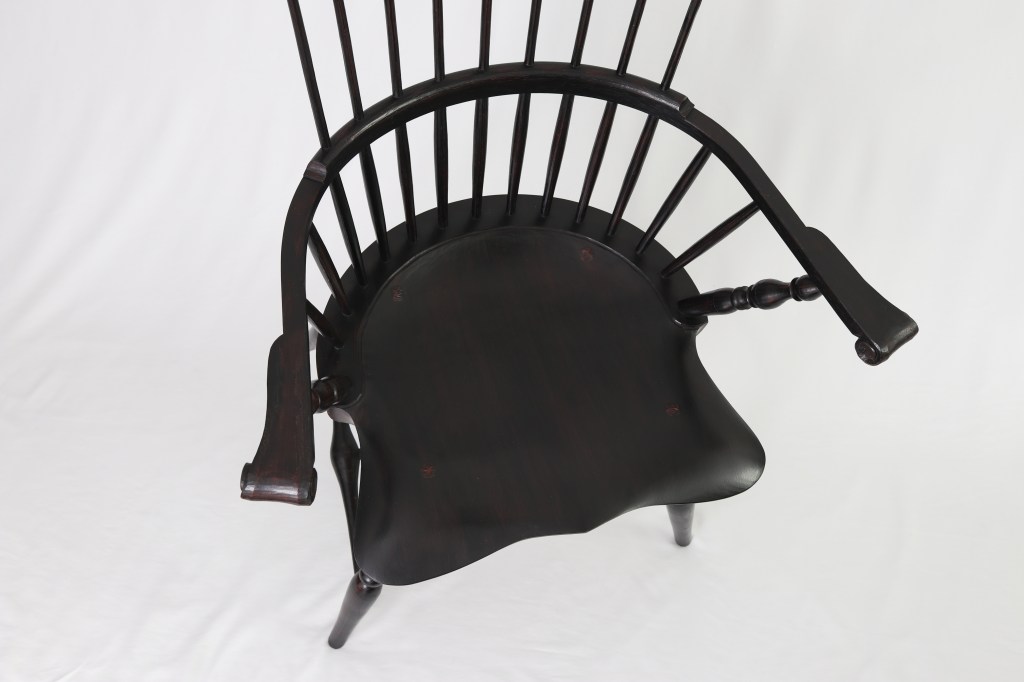
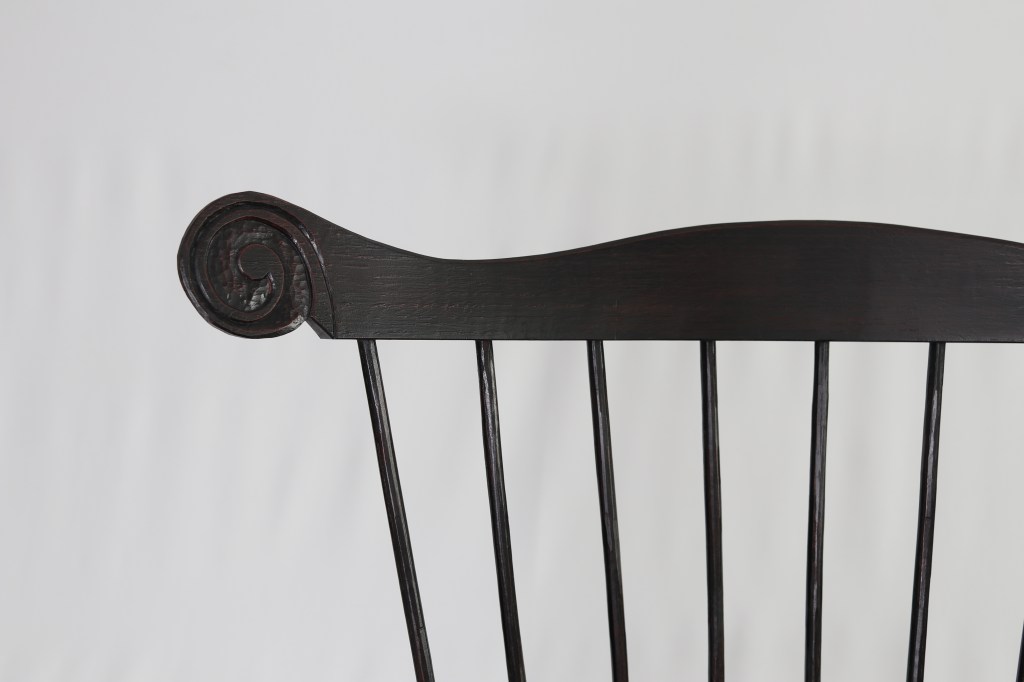
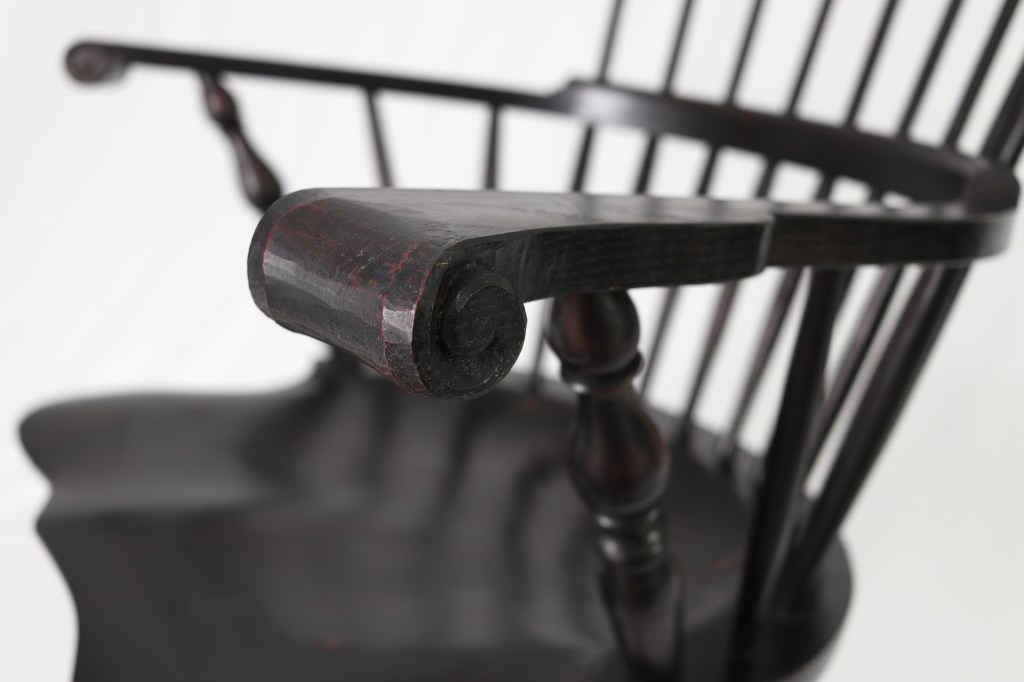
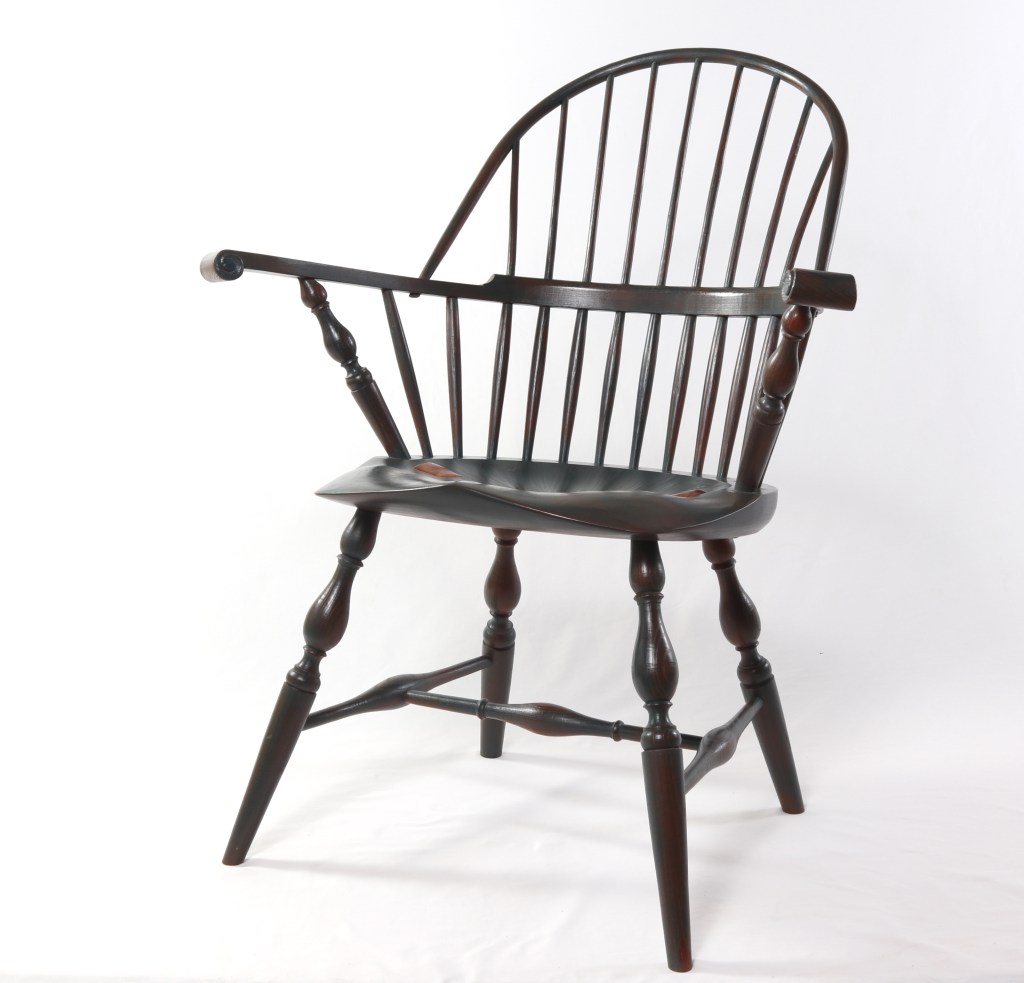
I just wrapped up work on this prototype Sack Back style Windsor chair. It’s a leap from the Comb Back I talked about in my previous post, all the angles from the feet to the arm bow are the same. I made some minor tweaks to the style of the turnings and knuckles, but the only major differences are the back bow and style of the seat.

The back bow, or hoop, is the most essential element to the style. For this chair I wanted the bow to land in roughly the same path of the spindles in the Comb Back. That makes the two chairs offer nearly identical support to the body.

The traditional seat for this type of chair is an oval with the grain running side to side (as opposed to the Comb Back whose shield seat has grain running front to back). The oval seat is often very narrow from front to back, so much so that the knuckles reach out past the front of the seat. To me it’s a gawky look but all makes sense, from what I’ve found the Sack Back was streamlined to be a more budget friendly armchair. Shield shaped seats are better suited for the Comb Back where the ramps (the curvy pedal bits to the side of the seat) are reflected in the ears of the comb. The Sack Back is all about curves, positive and negative curves, man. As a happy medium, I came up with this sort of hybrid shape, grain running left and right.
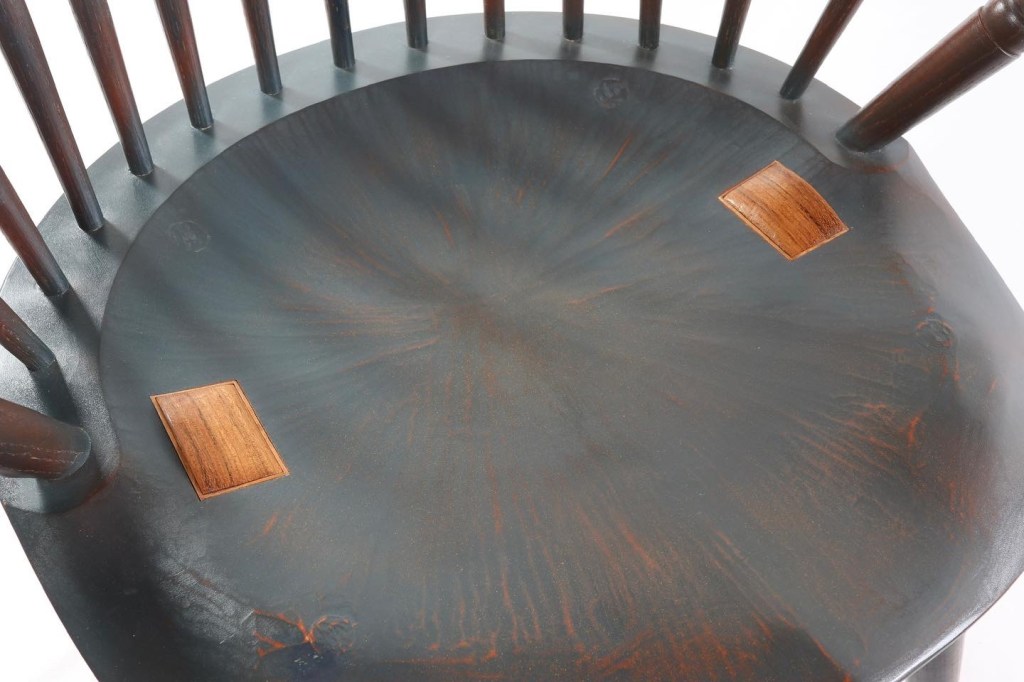
Common practice is to scrape and sand the seat smooth after shaping, but in recent years it’s been a trend to leave (or even go back and add) tool marks. It’s not a new idea but the broad desire for these facets, inconvenience of scraping and sanding, and my own proclivity for making hand planes had me wondering if I could do it tastefully on one of these classic chairs. I made two small planes (convex in both directions) for the final shaping and aimed to get the seat as smooth as possible, knowing the contrasting paint would amplify any texture. The result is bound to be polarizing, but the process was a pleasure and definitely something I’ll keep playing around with.
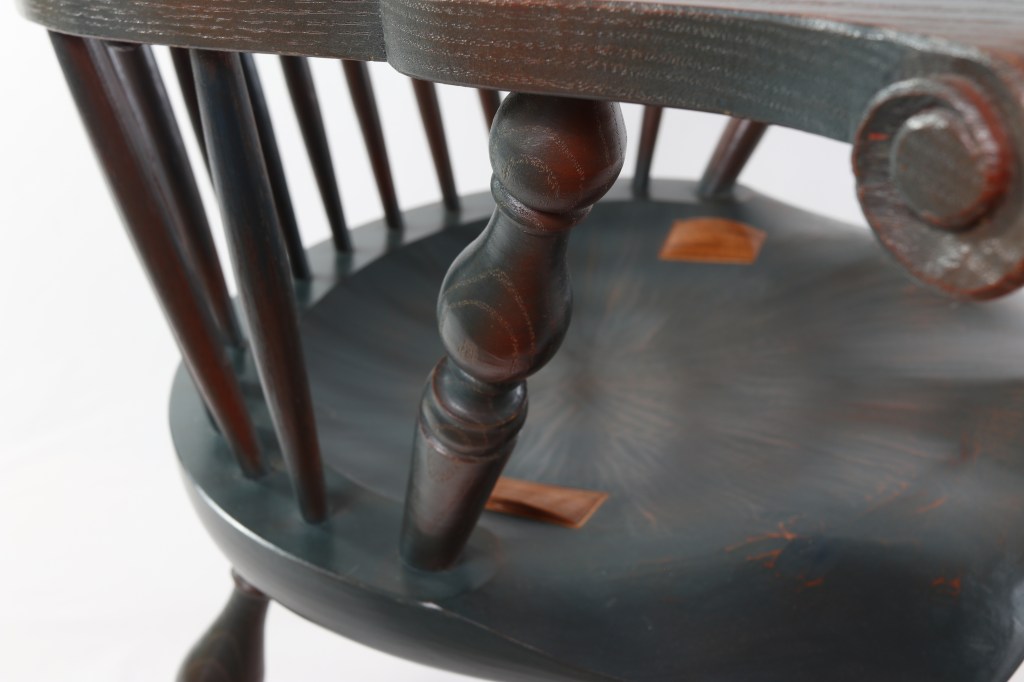
Paint is almost a given for Windsors, so color and finish are always variables. Since this chair was bound for my living room, I wanted to experiment with the painting process. From a distance it can look black, brown or green but up close you’ll see its a dark blue/green/orange ombre. Capturing the effect is beyond my own photography skills. And so is describing it, so just look at the photos and know that it’s not the red light on the camera. After painting I rubbed on a coat of boiled linseed oil to bring depth and saturation to the colors, and finished off with shellac and wax.

I won’t go into detail about the paint process just yet, because it wasn’t without a hitch. A few very small spots (and the better part of the back of that spindle bulb) were rejecting the paint. It’s not a concern for me, the rest of the surfaces held up great through the rigorous burnishing process. I’ll touch up these spots on this chair, and keep experimenting to work out any kinks. The effect is worth pursuing.

On to the next classic design, one to which I’m really looking forward to adding my own touch.
Comb Back Windsor Arm Chair

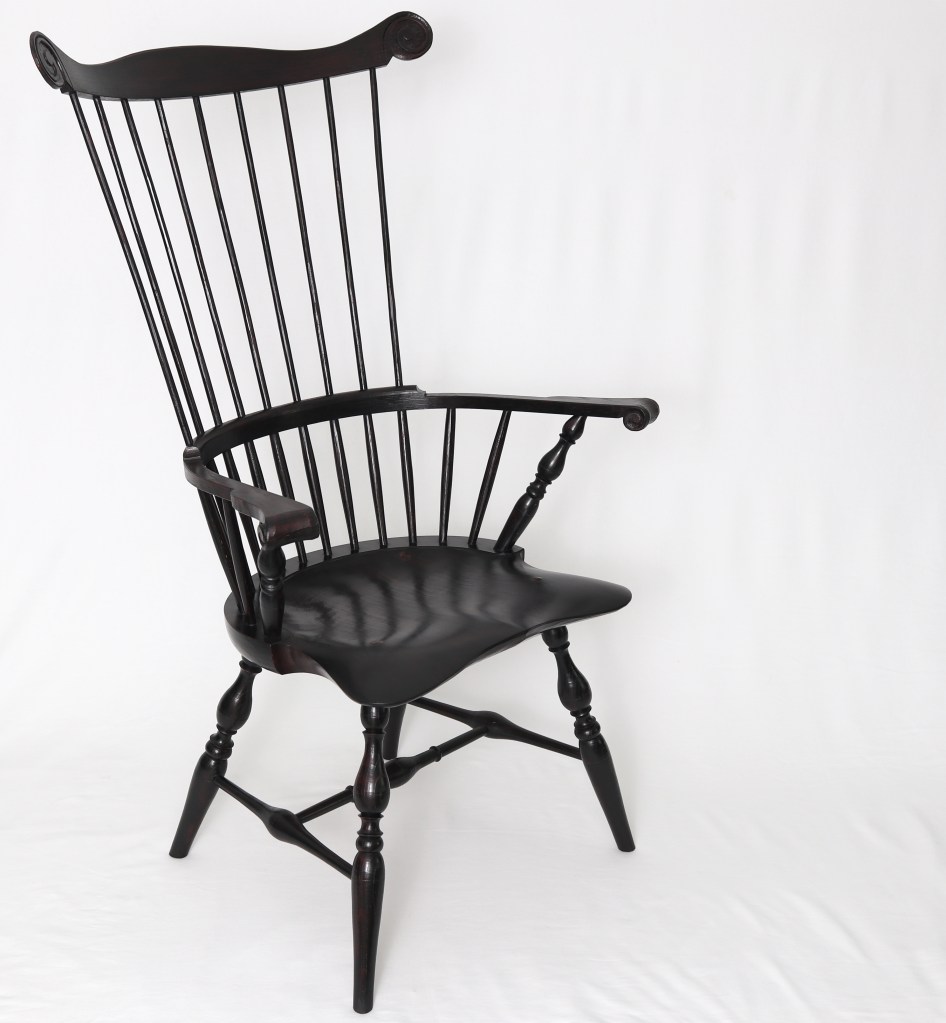
A little over a month ago I was approached to build this chair. It’s now in a charitable auction and available to General Electric employees and retirees. At the time I didn’t have drawings for this style of chair, and to design and build this type of chair in a month’s time is no small undertaking. Logs need to be sourced, bending forms made, bent parts need time to set, and moisture content of mating components needs to be kept under control. But this chair has occupied so much of my mind for the past few years that I couldn’t let the opportunity slip.

I have several reference books containing beautiful Windsor chairs, designs across different chair makers from the 18th and 19th centuries are remarkably consistent. Wallace Nutting’s Windsor Handbook gives some valuable input on some of the ideal measurements and aesthetics based on his famous collection of fine chairs. From there I made sense of the lines/curves/planes mathematically, and chose decorative features that suit my tools and methods.

On top of being a beautiful piece of Americana, Windsor chairs are a marvel of natural material science. Each component may be a different species. All but the seat are riven from choice logs, a process that I talk about in a previous post. The seat material must be lightweight and easily carved. The legs must be strong but hold crisp details when turned. The spindles must be a very strong but flexible wood, as the back moves with the posture of the sitter (this is a feature that Nutting considers essential to the structural integrity of the chair). The arm bow and comb must be able to take a bend, the former is a single stick bent nearly 180°.

The mechanics are remarkable as well. At the time of assembly the female halves of the joints are not fully dried, while the male halves are bone dry. Since wood shrinks as it drys (and vice versa) the joints lock together when they reach equilibrium. The joints between the legs, seat and arm supports are conical. This allows for the angles of those turnings to be fine tuned after the initial drilling, and means that the stability of the joint actually increases when the chair is occupied.

This armchair has a basswood seat, ash turnings and white oak spindles, arm bow and comb. It’s finished with a classic black over red milk paint scheme, shellac and buffed with wax.

When the black milk paint is burnished smooth, the red base coats show through highlighting the facets left from the planes, knives and carving tools that shaped the wood. The protective coats of shellac and wax leave a warm tactile surface that will patina over decades of uses.

Like Nightwing and Batman

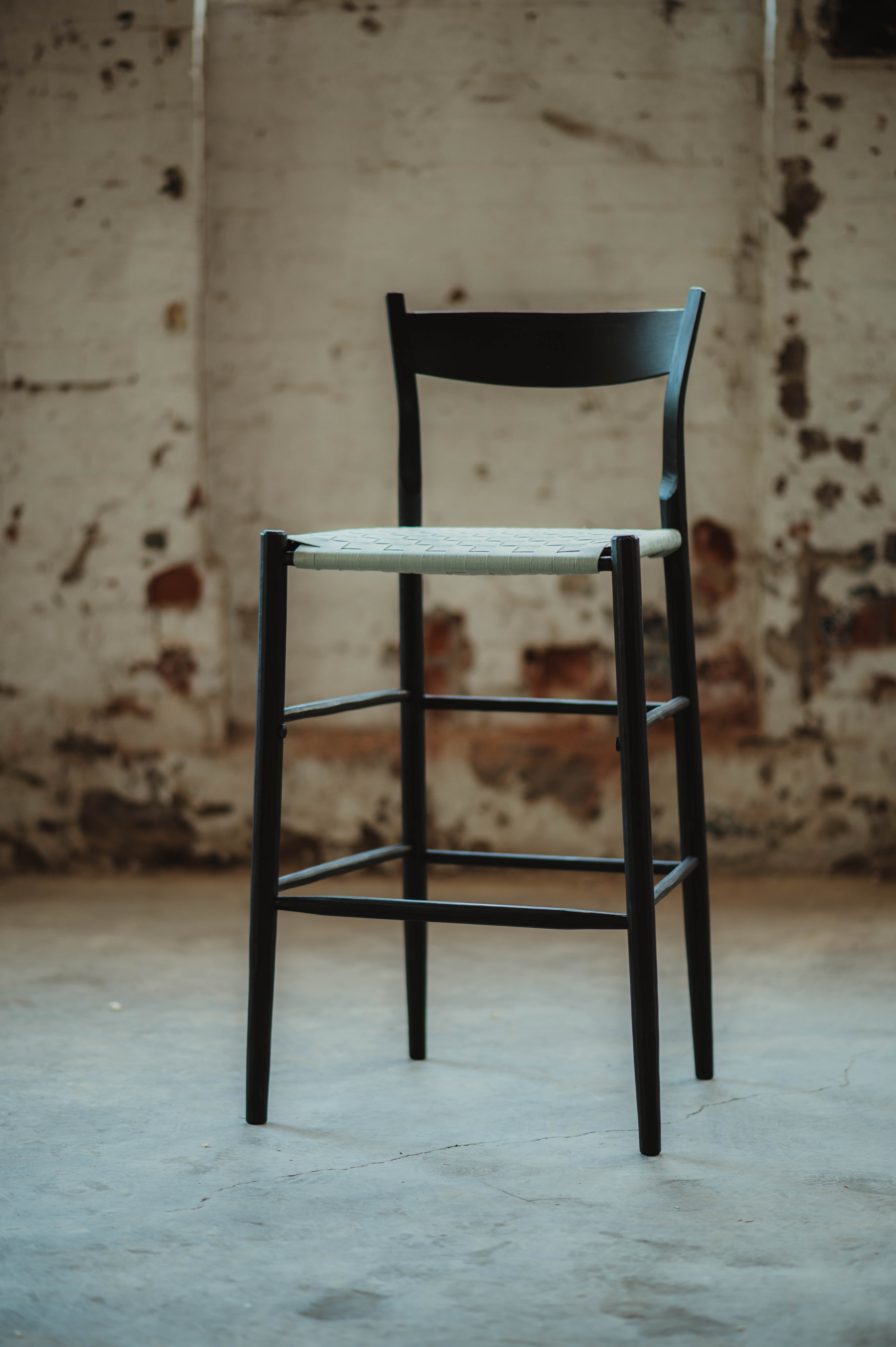
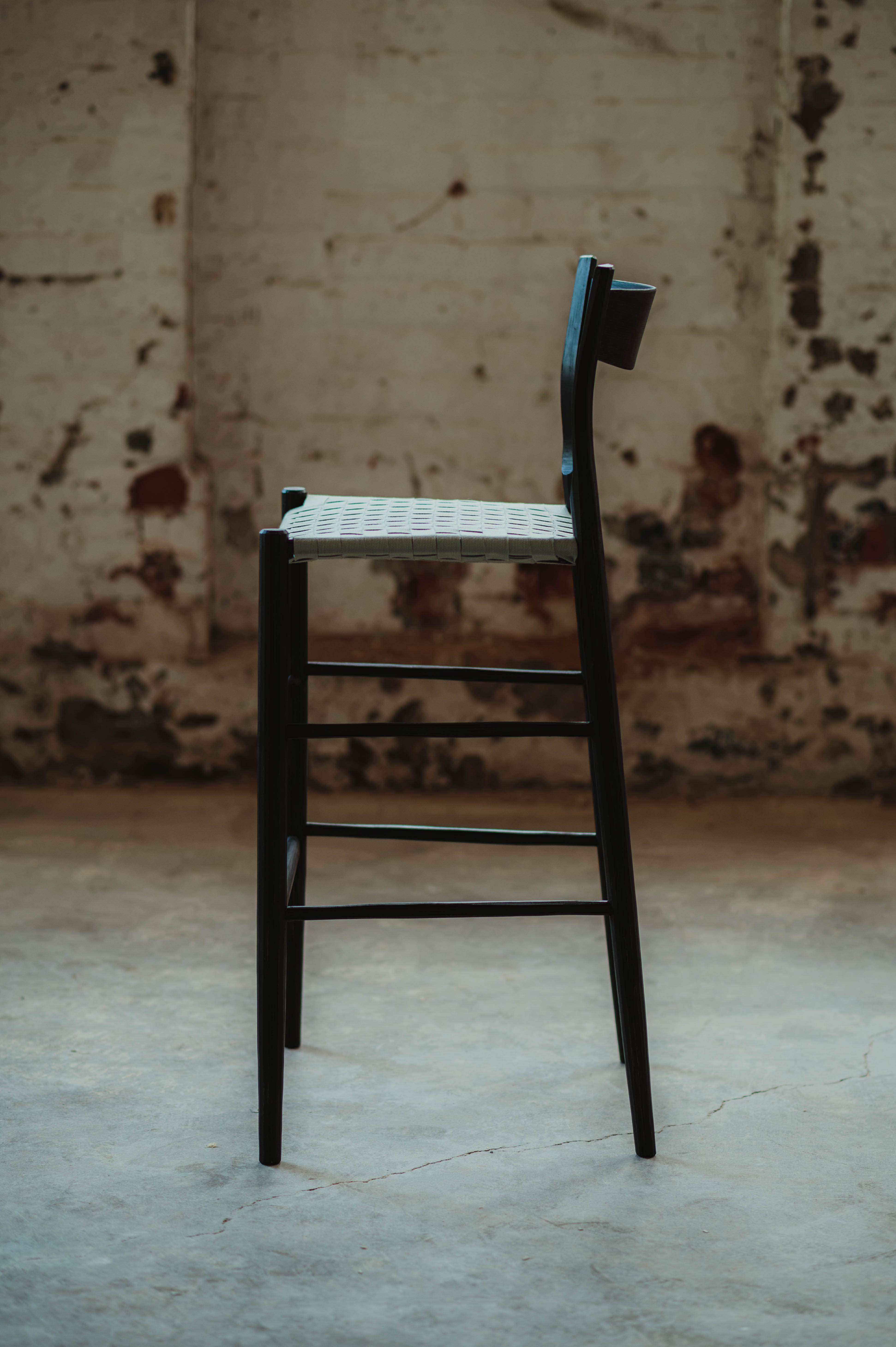
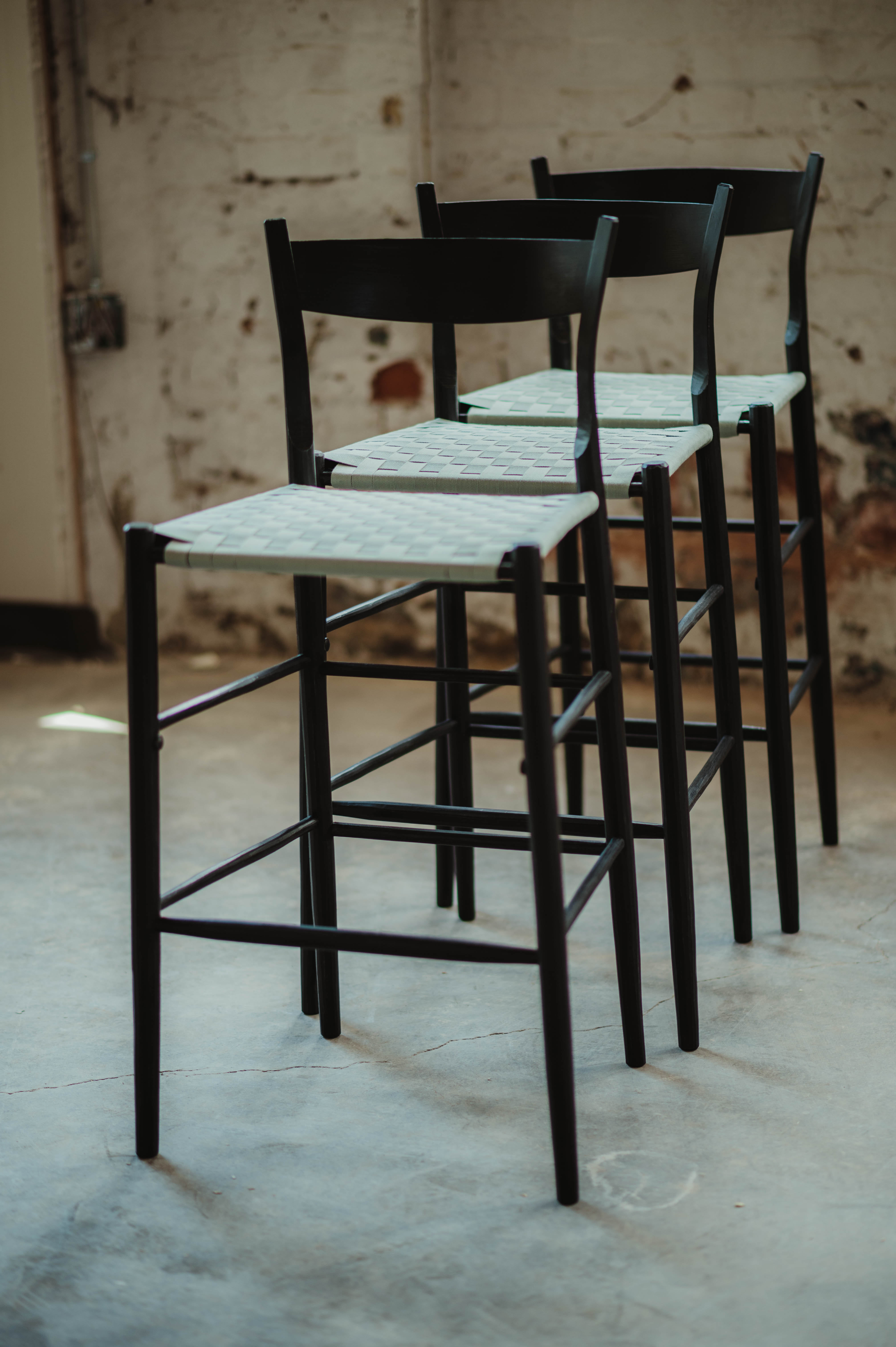
These chairs are white oak, painted with black over gray milk paint. The seat is gray shaker tape. It’s a counter height design that I’ve been working on, more comfortable than a stool and very easy to move around.

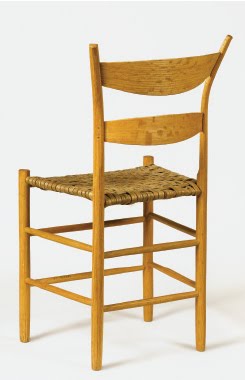
Photo’s from JA’s website www.greenwoodworking.com

Post and rung chairs date back ages, but my jumping off point in terms of design comes from the iconic Jennie Alexander chair (JA chair or simply Jennie chair). Alexander spent years studying the construction of chairs in the historical record, finding important elements that otherwise may have been lost in the wake of furniture industrialization. Based on her findings she developed a settin’ chair that is comfortable, lightweight, and robust. The construction starts with unseasoned “green” wood, so the process is novel for modern craftspeople but is not complicated. Alexander shares her design and how to build it in the book Make a Chair from a Tree.

Many chair makers that I admire have an interpretation of this chair that better suits their style of working and the wants/needs of their customers. Together their chairs are like an array of alternate universe comic book characters, quite different from one another but their links to Alexander’s chair are definitive.

This chair was constrained by height. Stretching the posts out to fit at a counter would make it an intimidating tower of a chair that probably wouldn’t be stable on the floor. To keep it approachable I went with a single back slat, high backs mostly come into play when you’re able to stretch your legs out in front of you (something that you don’t do as much when your feet aren’t touching the floor). Adding stability by widening the stance of the chair was an easy design change, but added angles and a lot of different rung lengths into the build process—I think the extra effort payed off in the end.

Other elements are left the same. Post and rung diameters are the same. The slats are from Alexander’s pattern. The back posts are even bent using the same bending form, though they are longer and the the relieved portions are shorter.

I left the components with facets and tried to embrace the subtle inconsistency of the oak, if the tree had a lump so does the rung that came from that section. The contrast of light on the black paint shows lines meandering along the sticks. It looks at home next to the salvaged 19th century door and window trim in the room they now live in.

As with any build the finished piece is infinitely more informative than an idea or a drawing. In the next round I will tweak some details, like the foot rest which I’d like to feel more developed than just a chubby rung.

With the way my schedule is shaking out it’ll be a few months before I am able to make more of these, but I won’t be slowing down on chairs. I bent some spare posts when I made these three, which I’ll cut down to use in a true Jennie chair. Then some dining chairs and windsor stuff…

A Small Windsor Stool is for Sale

Recently I’ve been doing a lot of experimenting, milling a lot of house trim for my parents’ 1880’s row house, and have inherited some very much appreciated raw materials from a friend who moved away. As a result the shop is packed to the gills. Getting from point A to point B has me feeling like Vincent Cassel in that Ocean’s Twelve scene.

It’s driving me nuts, so I’ve been spending some of my free time revisiting unfinished projects that I have sitting around and continuing to put awkward offcuts to use. I’ll be posting some of the products for sale here on the blog and and on my newly (and—as some of you know—very reluctantly) created Instagram.

For Sale: Small Maple and Ash Stool, $150
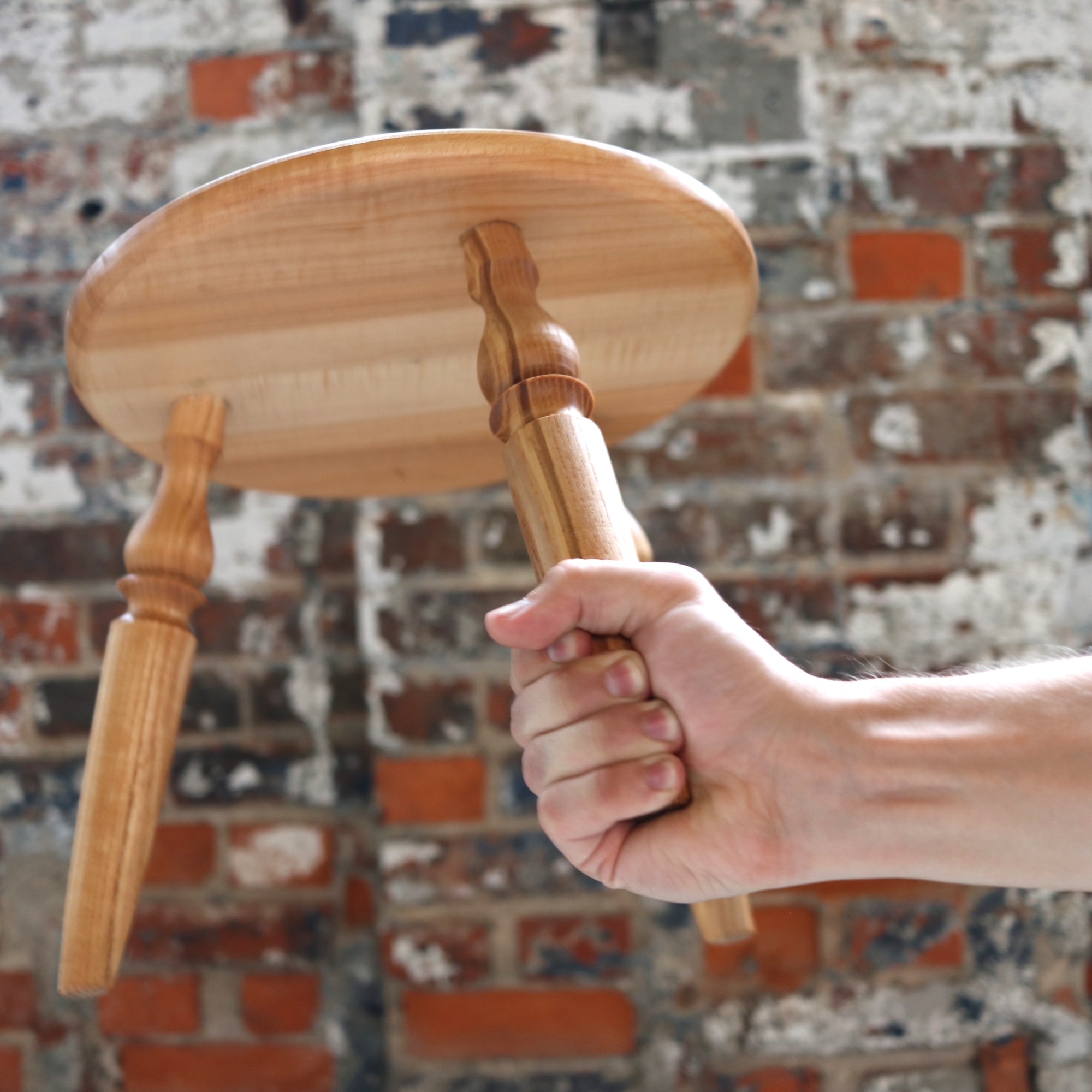
To get the ball rolling, I’ve got a little windsor style footstool (or a very little windsor style table). The top is hard maple with subtle curl in the grain, made from a longer narrow board cut down and joined edge to edge. This is a common industry practice that aside from allowing for wider pieces gives more control of the gain for aesthetics. It was originally the seat of a hairpin leg barstool that I was never happy with, mostly because I don’t like hairpin legged stools.

I replaced the hairpin structure with some decorative ash legs that I turned on my spring-pole lathe. The pole lathe is a reciprocating leg-powered tool that turns at a much lower rpm relative to modern electric lathes, that means the turnings often have more pronounced tool marks. Easier to seen in person than in these photos, I like the effect.

The original stool sat around in the shop for over a year, so there are some very minor blemishes. For that, as well as the fact that it’s a prototype/one-off I’m selling it at fair price that I can’t guarantee for anything similar that I make in the future.

If you’re interested or want to know more, please contact me here, directly by email or send me a DM on Instagram. I’ll edit this post to clearly state it’s sold when it’s no longer available.

Legwork

I went to a log yard the other day and bought an ash log to make a stockpile of legs for the stools. It’s pretty big so I should have plenty of wood to make all of the ash legged stools I want and have some left over for rehandling some old tools I have and other experimenting.

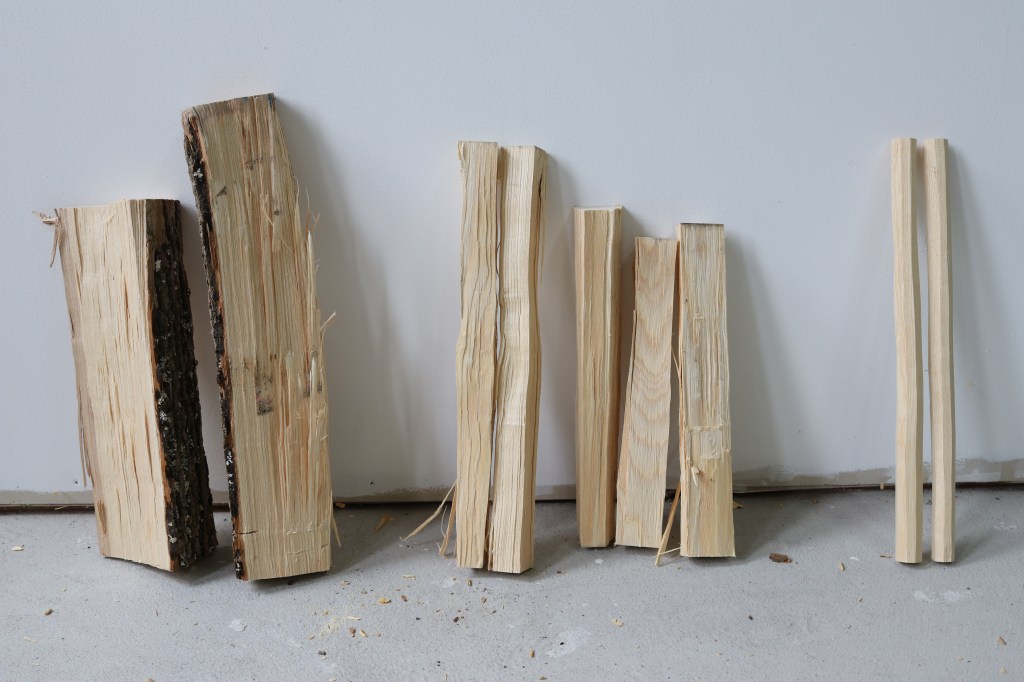
Not working to any particular measurements means I can use more of the log. I split it in half a few times (like cutting a pizza) with wedges, giving me manageable chunks to cut to length. I’m cutting between knots and swirls and curls which would be difficult to work with down the road.

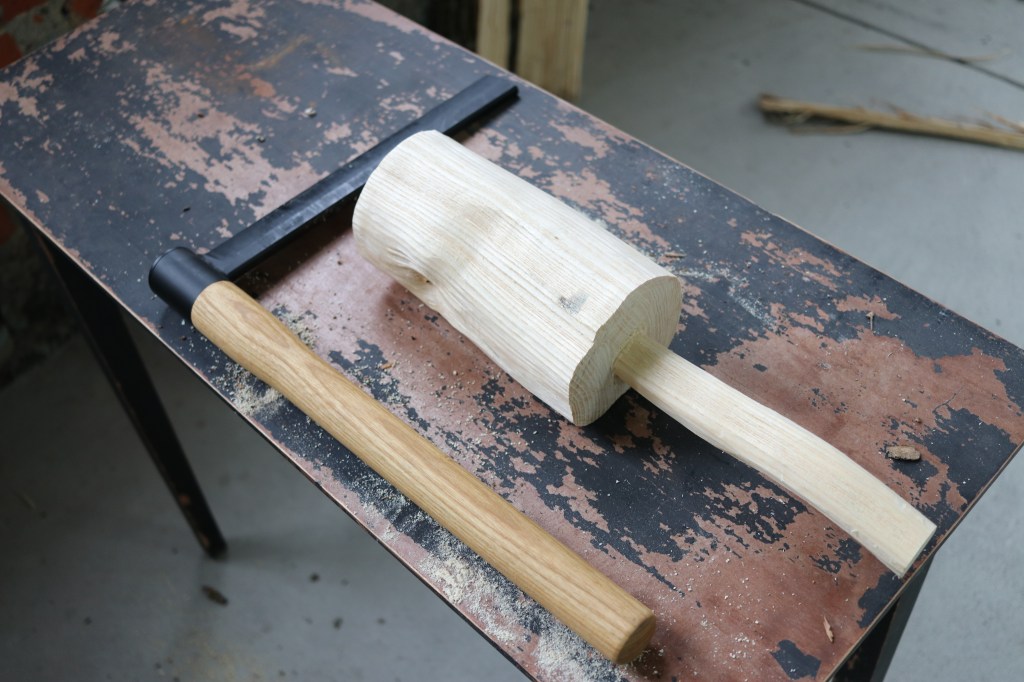
After cutting them to length I break the pieces down further with a froe, which allows for more control than a wedge. The froe gets smacked into the end of the wood with a club (I made this one from this log) and the log is split by pulling back on the froe’s handle.

Here I’m using the froe and a riving brake, which is just a few boards nailed together that allows for more control over the split.

Ideally after all the splitting I’m left with a squarish piece of wood that I can start shaving down with the drawknife.

Many people know what a drawknife is, it’s pretty straight forward, but fewer people are familiar with its partner, the shaving horse. The shaving horse, or shave horse, is a foot operated vise that you sit at like you’re riding a horse, hence the name I guess . It allows me to clamp and unclamp quickly as I shave, flip and turn the sticks around.

Using the drawknife I smooth the faces of the leg, following the wood fibers from bottom to top. Following the fibers means that the sticks don’t end up dead straight like I’d be going for with sawn and dried wood.

Why am I not sawing the legs out of a board? This is where eyes normally start glazing over so I’ll try to keep it brief. There are several reasons to use wood that is split fresh out of a log. Using split wood means that I can easily guarantee the legs are strong, with fibers going uninterrupted from bottom to top. Wood is easier to cut before it’s fully dried. The process is more dynamic and enjoyable than listening to power tools WHRRR for hours. There’s almost no dust. It’s good practice for other chair parts that have even more practical benefits of being split green.

I’ll keep stockpiling these legs until I run out of log. Once I’ve got a good number of them to choose from, I’ll start putting them into sets of four based on their length and thickness. Then I’ll taper them and get them looking like legs before putting them in my low temperature kiln to dry.