
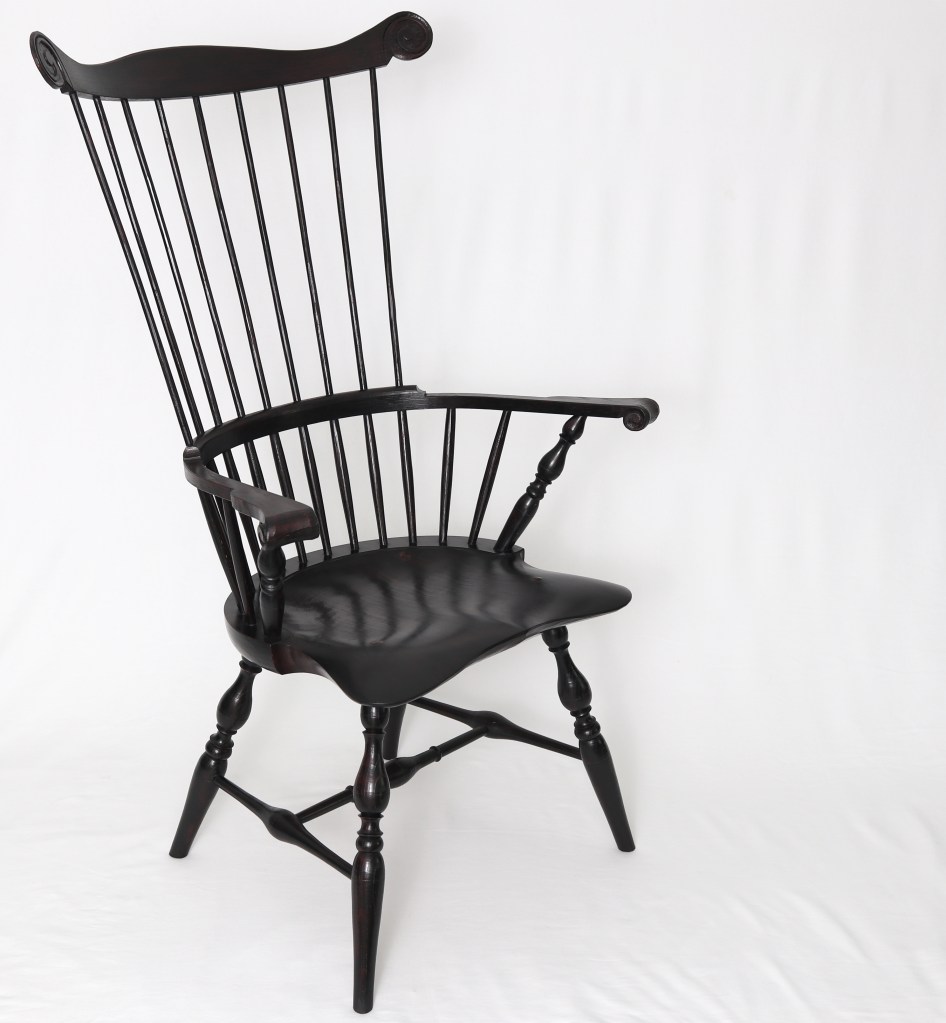
A little over a month ago I was approached to build this chair. It’s now in a charitable auction and available to General Electric employees and retirees. At the time I didn’t have drawings for this style of chair, and to design and build this type of chair in a month’s time is no small undertaking. Logs need to be sourced, bending forms made, bent parts need time to set, and moisture content of mating components needs to be kept under control. But this chair has occupied so much of my mind for the past few years that I couldn’t let the opportunity slip.
I have several reference books containing beautiful Windsor chairs, designs across different chair makers from the 18th and 19th centuries are remarkably consistent. Wallace Nutting’s Windsor Handbook gives some valuable input on some of the ideal measurements and aesthetics based on his famous collection of fine chairs. From there I made sense of the lines/curves/planes mathematically, and chose decorative features that suit my tools and methods.
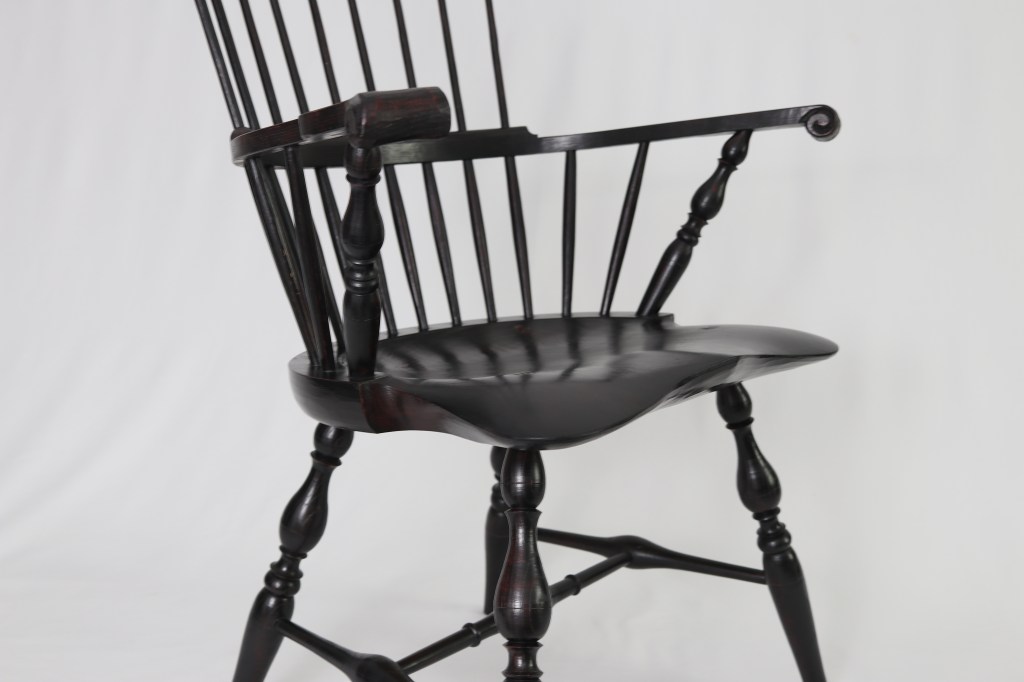
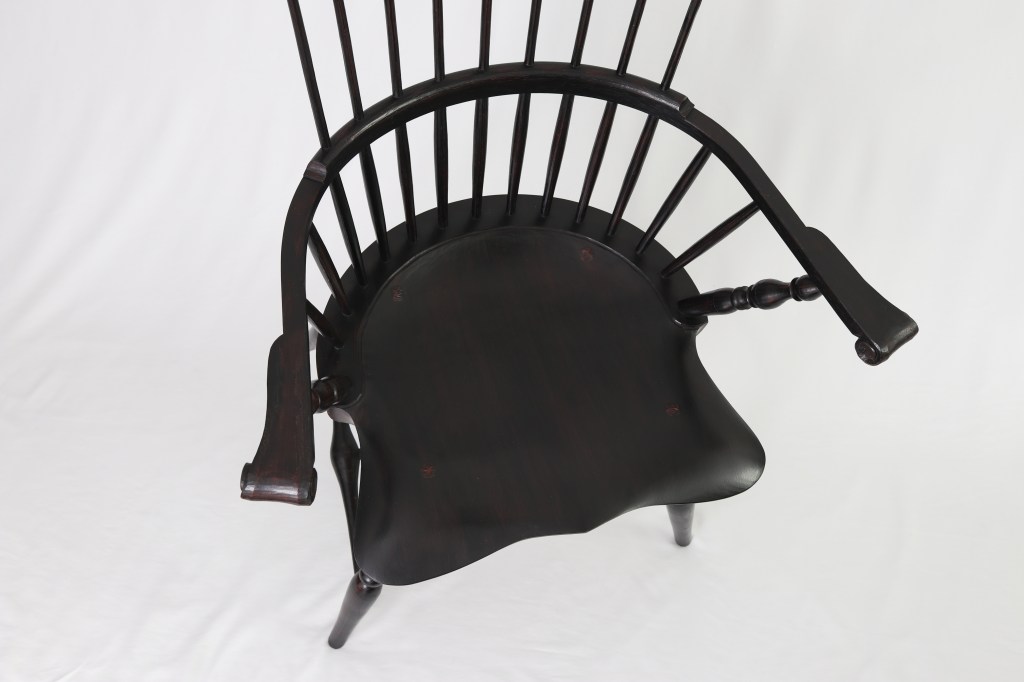
On top of being a beautiful piece of Americana, Windsor chairs are a marvel of natural material science. Each component may be a different species. All but the seat are riven from choice logs, a process that I talk about in a previous post. The seat material must be lightweight and easily carved. The legs must be strong but hold crisp details when turned. The spindles must be a very strong but flexible wood, as the back moves with the posture of the sitter (this is a feature that Nutting considers essential to the structural integrity of the chair). The arm bow and comb must be able to take a bend, the former is a single stick bent nearly 180°.
The mechanics are remarkable as well. At the time of assembly the female halves of the joints are not fully dried, while the male halves are bone dry. Since wood shrinks as it drys (and vice versa) the joints lock together when they reach equilibrium. The joints between the legs, seat and arm supports are conical. This allows for the angles of those turnings to be fine tuned after the initial drilling, and means that the stability of the joint actually increases when the chair is occupied.
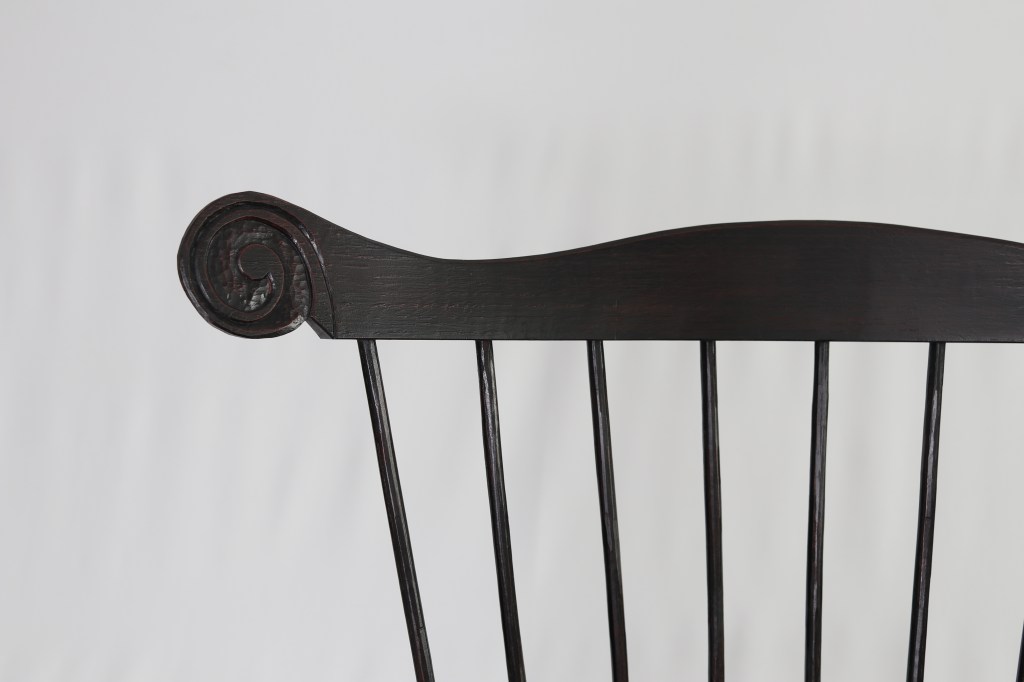

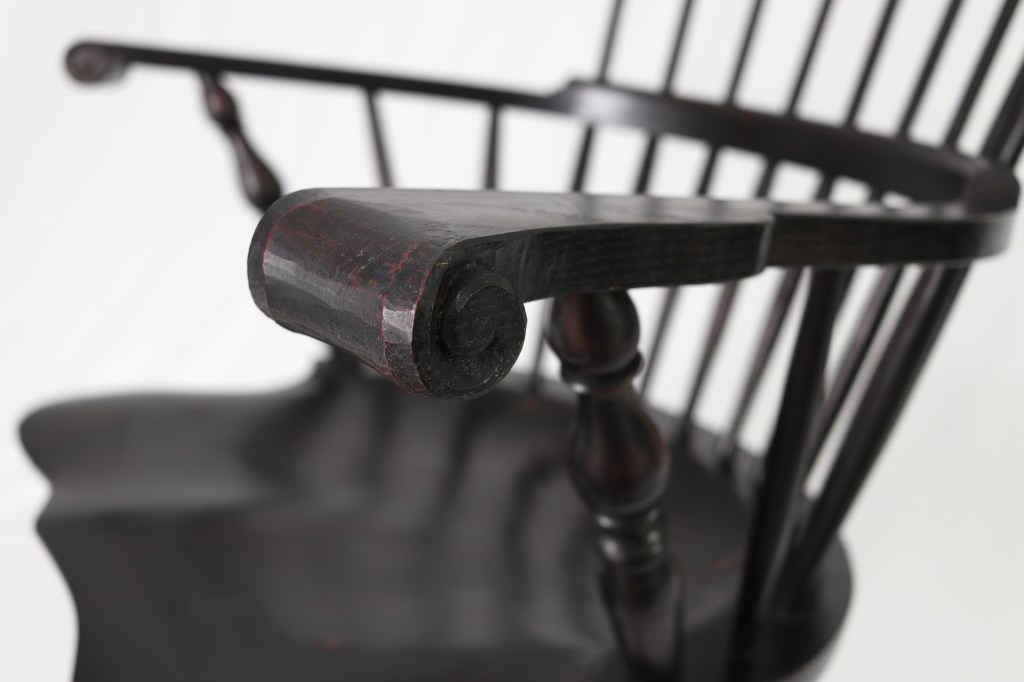
This armchair has a basswood seat, ash turnings and white oak spindles, arm bow and comb. It’s finished with a classic black over red milk paint scheme, shellac and buffed with wax.
When the black milk paint is burnished smooth, the red base coats show through highlighting the facets left from the planes, knives and carving tools that shaped the wood. The protective coats of shellac and wax leave a warm tactile surface that will patina over decades of uses.

 Just James