
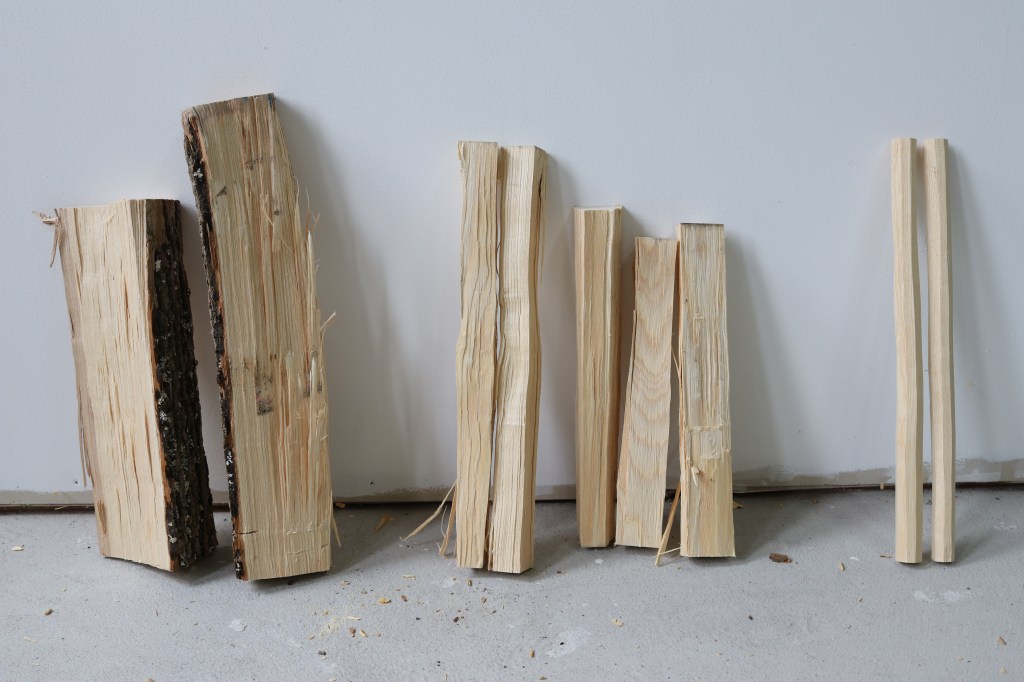
I went to a log yard the other day and bought an ash log to make a stockpile of legs for the stools. It’s pretty big so I should have plenty of wood to make all of the ash legged stools I want and have some left over for rehandling some old tools I have and other experimenting.

Not working to any particular measurements means I can use more of the log. I split it in half a few times (like cutting a pizza) with wedges, giving me manageable chunks to cut to length. I’m cutting between knots and swirls and curls which would be difficult to work with down the road.
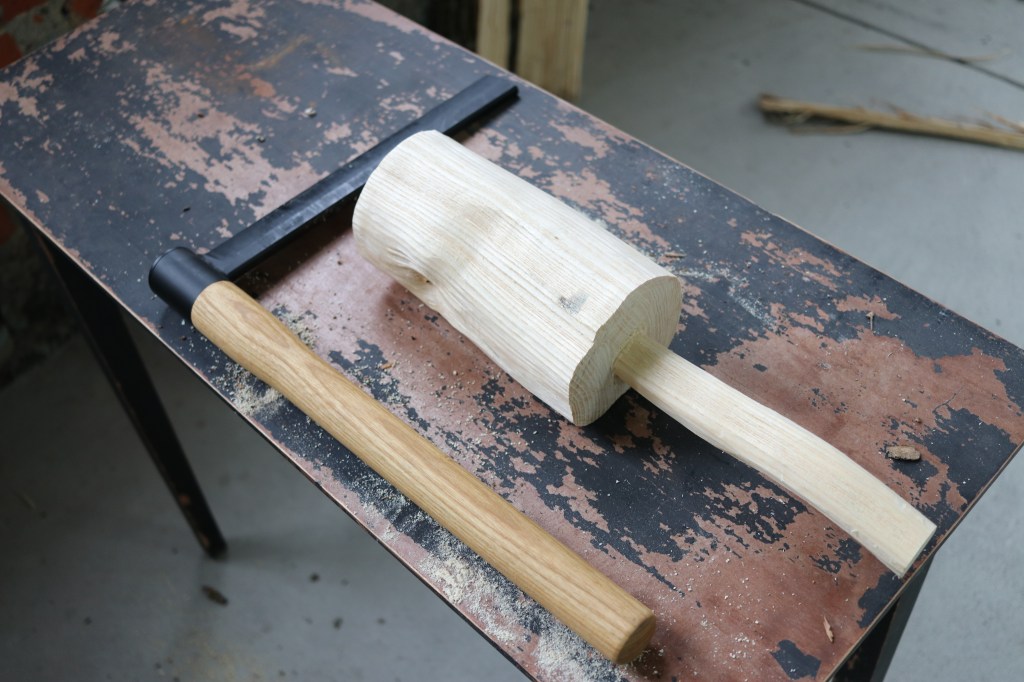
After cutting them to length I break the pieces down further with a froe, which allows for more control than a wedge. The froe gets smacked into the end of the wood with a club (I made this one from this log) and the log is split by pulling back on the froe’s handle.


Here I’m using the froe and a riving brake, which is just a few boards nailed together that allows for more control over the split.
Ideally after all the splitting I’m left with a squarish piece of wood that I can start shaving down with the drawknife.

Many people know what a drawknife is, it’s pretty straight forward, but fewer people are familiar with its partner, the shaving horse. The shaving horse, or shave horse, is a foot operated vise that you sit at like you’re riding a horse, hence the name I guess . It allows me to clamp and unclamp quickly as I shave, flip and turn the sticks around.
Using the drawknife I smooth the faces of the leg, following the wood fibers from bottom to top. Following the fibers means that the sticks don’t end up dead straight like I’d be going for with sawn and dried wood.
Why am I not sawing the legs out of a board? This is where eyes normally start glazing over so I’ll try to keep it brief. There are several reasons to use wood that is split fresh out of a log. Using split wood means that I can easily guarantee the legs are strong, with fibers going uninterrupted from bottom to top. Wood is easier to cut before it’s fully dried. The process is more dynamic and enjoyable than listening to power tools WHRRR for hours. There’s almost no dust. It’s good practice for other chair parts that have even more practical benefits of being split green.

I’ll keep stockpiling these legs until I run out of log. Once I’ve got a good number of them to choose from, I’ll start putting them into sets of four based on their length and thickness. Then I’ll taper them and get them looking like legs before putting them in my low temperature kiln to dry.

 Just James